Quick Answer
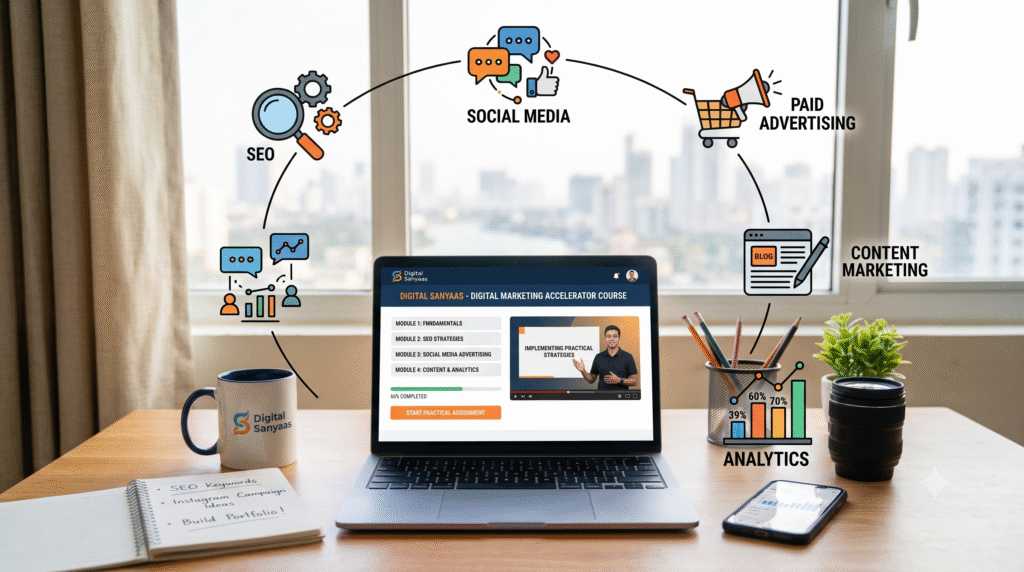
A digital marketing course online teaches essential skills such as SEO, social media marketing, Google Ads, Meta Ads, content marketing, email marketing, analytics, and online advertising. Online courses are suitable for students, beginners, business owners, freelancers, and professionals who want to develop practical digital marketing skills from anywhere. The right course should provide structured learning, practical projects, updated content, and guidance on applying marketing strategies to real businesses.
Introduction
Digital marketing has become an essential skill for businesses, professionals, freelancers, and entrepreneurs. As more customers search, shop, communicate, and make purchasing decisions online, companies need skilled people who understand how to attract and convert digital audiences.
A digital marketing course online provides a flexible way to learn these skills without attending a traditional classroom. You can learn SEO, social media marketing, paid advertising, content marketing, email marketing, analytics, and other important areas from anywhere.
Online learning is particularly useful for beginners because it allows you to study at your own pace and revisit lessons whenever necessary. Instead of trying to learn every digital marketing concept randomly, a structured course can give you a clear learning path.
If you’re considering a career in digital marketing, starting a business, freelancing, or improving your existing professional skills, an online course can provide a practical foundation.
In this guide, we’ll explain what a digital marketing course online teaches, who should take one, what skills you can develop, how to choose the right course, and what career opportunities are available after learning digital marketing.
What Is a Digital Marketing Course Online?
A digital marketing course online is a structured learning program that teaches students how businesses promote products and services through digital channels.
Depending on the course, you may learn:
- Search Engine Optimization (SEO)
- Social media marketing
- Google Ads
- Meta Ads
- Content marketing
- Email marketing
- Affiliate marketing
- Website analytics
- Conversion optimization
- Online branding
- Lead generation
The biggest advantage of online learning is flexibility. You don’t necessarily need to attend classes at a fixed location or follow a traditional classroom schedule.
You can learn using:
- Video lessons
- Online tutorials
- Practical assignments
- Marketing projects
- Quizzes
- Case studies
- Live sessions
- Downloadable resources
A good course should focus not only on theory but also on practical implementation.
Why Learn Digital Marketing Online in 2026?
The digital economy continues to create opportunities for people with practical online marketing skills.
1. Learn From Anywhere
One of the biggest benefits of a digital marketing course online is location flexibility.
You can learn from:
- Home
- Office
- College
- A coworking space
- While travelling
All you need is an internet connection and a suitable device.
2. Flexible Learning Schedule
Traditional education often follows fixed schedules. Online courses provide greater flexibility.
You can study:
- Before work
- After college
- On weekends
- During free time
This makes online learning suitable for students and working professionals.
3. Develop Practical Skills
Digital marketing is a practical field.
Instead of simply memorizing concepts, you can practice:
- Keyword research
- Website optimization
- Ad campaign creation
- Social media planning
- Content writing
- Analytics
- Competitor research
Practical experience can make it easier to understand how digital marketing works in real-world situations.
4. Learn Multiple Marketing Channels
Digital marketing includes many different channels.
A comprehensive course can help you understand how these channels work together.
For example:
SEO → Website Traffic → Content → Lead Generation → Email Marketing → Sales
Understanding this complete customer journey is more valuable than learning individual marketing techniques in isolation.
What Will You Learn in a Digital Marketing Course Online?
A good course should cover the core areas of digital marketing.
Search Engine Optimization (SEO)
SEO helps websites appear higher in search engine results.
You may learn:
- Keyword research
- On-page SEO
- Technical SEO
- Off-page SEO
- Internal linking
- Content optimization
- SEO analytics
For example, if a digital marketing website wants to rank for digital marketing course online, an SEO strategy would involve creating useful content around that search intent and optimizing relevant pages.
Social Media Marketing
Social media marketing involves promoting a brand through platforms such as:
- YouTube
- X
You’ll learn how to create content strategies, understand audiences, increase engagement, and build a consistent brand presence.
For a broader understanding of this topic, you can explore our guide to Social Media Marketing in 2026.
Google Ads
Google Ads allows businesses to advertise when people actively search for products or services.
A course may teach:
- Search campaigns
- Keyword targeting
- Ad copy
- Conversion tracking
- Campaign optimization
- Performance analysis
Meta Ads
Meta Ads help businesses advertise across Facebook and Instagram.
You’ll learn about:
- Campaign objectives
- Audience targeting
- Ad creatives
- Retargeting
- Campaign optimization
- Conversion tracking
Understanding Meta Ads is especially useful for businesses that depend on social media for customer acquisition.
Content Marketing
Content is an important part of modern digital marketing.
Content marketing can include:
- Blog posts
- Videos
- Social media posts
- Infographics
- Guides
- Case studies
- Email newsletters
The objective is to provide useful information that attracts potential customers and builds trust.
Email Marketing
Email marketing helps businesses communicate directly with potential and existing customers.
You may learn how to create:
- Promotional emails
- Newsletters
- Welcome sequences
- Lead nurturing campaigns
- Product announcements
Analytics and Reporting
Marketing decisions should be based on data.
You’ll learn how to monitor metrics such as:
- Website traffic
- Click-through rate
- Conversion rate
- Cost per lead
- Return on ad spend
- User engagement
Analytics helps marketers understand what’s working and what needs improvement.
Who Should Take a Digital Marketing Course Online?
Online digital marketing education isn’t limited to one type of learner.
Students
Students can develop practical skills before entering the job market.
Learning digital marketing can help students explore careers in:
- SEO
- Social media
- Paid advertising
- Content marketing
- Email marketing
- Analytics
Beginners
If you’re starting from zero, a structured course can provide a clear learning path instead of forcing you to search for random tutorials.
For beginners, it’s useful to first understand the fundamentals and then specialize in areas such as SEO, advertising, or social media.
Business Owners
Business owners can use digital marketing knowledge to understand how their marketing campaigns work.
This can help them:
- Generate leads
- Increase website traffic
- Improve online visibility
- Build brand awareness
- Understand advertising performance
Freelancers
Digital marketing is also suitable for people interested in freelancing.
Freelancers can offer services such as:
- SEO
- Social media management
- Content marketing
- Google Ads
- Meta Ads
- Website optimization
Working Professionals
Professionals can learn digital marketing to improve their existing skill set or explore new career opportunities.
How to Choose the Best Digital Marketing Course Online
Not every course offers the same level of quality.
Before enrolling, consider these factors.
1. Course Curriculum
Check whether the course covers important areas such as:
- SEO
- Social media
- Paid advertising
- Content marketing
- Analytics
- Email marketing
Avoid courses that promise to teach “everything” but provide very little practical information.
2. Practical Projects
Practical assignments are extremely important.
Look for courses that allow you to work on:
- Websites
- SEO projects
- Advertising campaigns
- Content strategies
- Social media calendars
Practical work helps turn theoretical knowledge into usable skills.
3. Updated Content
Digital marketing changes frequently.
Search engines, advertising platforms, social networks, and analytics tools continuously evolve.
Therefore, choose a course that updates its content regularly.
4. Beginner-Friendly Structure
If you are new to digital marketing, the course should explain concepts clearly.
A good learning path might look like:
Digital Marketing Basics → SEO → Content → Social Media → Paid Ads → Analytics → Practical Projects
This structure makes learning easier.
5. Career Guidance
If your goal is employment, look for additional support such as:
- Resume guidance
- Interview preparation
- Portfolio development
- Freelancing guidance
- Practical projects
Digital Marketing Course Online vs Classroom Course
Both online and classroom learning have advantages.
| Feature | Online Course | Classroom Course |
|---|---|---|
| Location flexibility | High | Low |
| Schedule flexibility | High | Usually limited |
| Learning pace | Flexible | Fixed |
| Accessibility | Anywhere with internet | Physical location |
| Practical learning | Depends on course | Depends on course |
| Cost | Often flexible | Can be higher |
The best choice depends on your learning style, schedule, budget, and career goals.
For many beginners, online learning provides a convenient way to build skills while continuing college, work, or business activities.
How Long Does It Take to Learn Digital Marketing?
There is no single timeline for learning digital marketing.
A beginner can understand the fundamentals relatively quickly, but becoming proficient requires consistent practice.
A possible learning roadmap is:
Month 1: Fundamentals
Learn:
- Digital marketing basics
- Customer journey
- Marketing channels
- Basic SEO
- Content marketing
Month 2: Core Skills
Focus on:
- SEO
- Social media marketing
- Google Ads
- Meta Ads
Month 3: Practical Projects
Work on:
- Keyword research
- Website optimization
- Social media strategy
- Sample advertising campaigns
- Analytics reports
Month 4 and Beyond: Specialization
Choose an area to specialize in:
- SEO
- Paid advertising
- Social media marketing
- Content marketing
- Analytics
The important factor isn’t simply how many hours you spend watching lessons. It’s how much you practice.
Career Opportunities After a Digital Marketing Course
Digital marketing skills can lead to several career paths.
SEO Specialist
SEO specialists help websites improve their visibility in search engines.
Social Media Manager
Social media managers plan and manage content across social platforms.
Performance Marketing Specialist
Performance marketers manage paid campaigns and focus on measurable business results.
Content Marketing Specialist
Content marketers create strategies designed to attract and engage audiences.
Digital Marketing Executive
Digital marketing executives often work across multiple marketing channels.
Freelancer
Freelancers can work with businesses directly and provide specialized digital marketing services.
Entrepreneur
Business owners can use digital marketing skills to promote their own products and services.
Why Practical Learning Matters
Watching videos alone doesn’t make someone a digital marketer.
You need to apply what you learn.
For example, after learning SEO, try optimizing a real website.
After learning social media marketing, create a content calendar.
After learning paid advertising, build a sample campaign and analyze the expected customer journey.
Practical learning helps you understand how different marketing channels work together.
If you’re considering structured digital marketing education, our guide on Why You Should Join a Digital Marketing Course Online in 2026 explains some of the key benefits of learning digital marketing through an online course.
How to Build a Digital Marketing Portfolio
A portfolio can be extremely valuable when applying for jobs or finding freelance clients.
You can create sample projects such as:
- SEO audit
- Keyword research report
- Blog optimization project
- Social media strategy
- Google Ads campaign plan
- Meta Ads campaign plan
- Competitor analysis
You don’t necessarily need dozens of projects.
Start with three to five strong examples that demonstrate your ability to solve marketing problems.
Common Mistakes Beginners Should Avoid
Trying to Learn Everything at Once
Digital marketing is a broad field.
Start with the fundamentals and gradually specialize.
Focusing Only on Certificates
A certificate can demonstrate course completion, but practical skills matter more.
Focus on what you can actually do.
Ignoring Analytics
If you don’t measure results, you won’t know whether your marketing is working.
Learn basic analytics early.
Copying Other Businesses
Competitor research is useful, but simply copying another brand’s strategy rarely produces sustainable results.
Understand the reason behind each strategy and adapt it to your audience.
Expecting Instant Results
SEO, content marketing, social media, and paid advertising all require testing and optimization.
Digital marketing is a long-term skill, not a shortcut to instant success.
Tips for Getting the Most From an Online Course
Follow these steps:
- Create a weekly learning schedule.
- Take notes during lessons.
- Practice each new concept.
- Build real or sample projects.
- Track your progress.
- Study successful campaigns.
- Keep learning after completing the course.
The goal should be to become capable of applying digital marketing—not simply finishing lessons.
Is a Digital Marketing Course Online Worth It?
For many learners, yes.
An online course can provide:
- Structured learning
- Flexible study
- Practical skills
- Career knowledge
- Business marketing knowledge
- A foundation for specialization
However, the value depends heavily on the quality of the course and your commitment to practice.
Before choosing a course, compare its curriculum, practical assignments, learning support, updates, and overall structure.
Start Your Digital Marketing Learning Journey
If you’re serious about developing digital marketing skills, don’t wait until you understand everything before starting.
Begin with the fundamentals, practice consistently, and gradually move toward advanced topics such as SEO, paid advertising, analytics, and conversion optimization.
You can also explore our guide to Digital Marketing Online in 2026 to understand the broader digital marketing landscape and the skills businesses are increasingly using.
The right learning path can help you move from basic concepts to practical marketing skills step by step.
Frequently Asked Questions
1. What is a digital marketing course online?
A digital marketing course online is a structured program that teaches marketing skills such as SEO, social media marketing, Google Ads, Meta Ads, content marketing, email marketing, and analytics through online learning.
2. Is a digital marketing course online suitable for beginners?
Yes. Many online courses are designed specifically for beginners and start with fundamental concepts before moving into advanced marketing strategies.
3. How long does it take to learn digital marketing online?
The time varies depending on your learning schedule and goals. You can learn the fundamentals in a few months, but developing strong practical skills requires continued practice and real-world projects.
4. Can I get a job after completing a digital marketing course?
Yes. Digital marketing skills can prepare you for roles such as SEO executive, social media manager, content marketer, performance marketing specialist, and digital marketing executive. Your practical skills and portfolio are important factors when applying for jobs.
5. Is an online digital marketing course worth it in 2026?
An online course can be worthwhile if it provides updated content, practical projects, structured learning, and relevant industry skills. Your results will also depend on how consistently you practice and apply what you learn.
Conclusion
A digital marketing course online can be an effective way to develop practical marketing skills from anywhere. Whether you’re a student, beginner, freelancer, business owner, or working professional, online learning provides flexibility while allowing you to build knowledge across important areas such as SEO, social media marketing, paid advertising, content marketing, and analytics.
The most important thing is to choose a course that focuses on current strategies and practical learning rather than theory alone.
Start with the fundamentals, practice what you learn, build a portfolio, and gradually specialize in the area of digital marketing that matches your career or business goals.
If you’re ready to start learning, explore the resources available through Digital Sanyaas and build your digital marketing knowledge step by step.